Skip to content
João Pedro Lira

Fullstack Developer · Go + Next.js

I build fast Go backends and interfaces people understand.

I'm a fullstack developer at PontoGO. I work on Go APIs, Redis caching, and React, Next.js and React Native apps that run in production. I have a degree in Psychology, which left me with the habit of understanding the problem before thinking about code.

Currently
Fullstack @ PontoGO
Location
Fortaleza, Brazil
Languages
PT native · EN advanced
dev.go
package main

// what I ship, from UI to server
var joao = Dev{
  Name:     "João Pedro Lira",
  Role:     "Fullstack @ PontoGO",
  Backend:  []string{"Go", "Redis", "Postgres"},
  Frontend: []string{"Next.js", "React", "RN"},
  Learning: "Software Eng. + AI",
}

func main() {
  joao.Ship(ctx, "your next product")
}

What I've shipped to production

  • Redis caching

    On a Redis caching project, I implemented the caches and their invalidation.

  • Concurrent Go

    I write and tune Go APIs, using concurrency to cut latency on the busiest flows.

  • Deploys and releases

    I own deployments and app releases to production.

  • People

    I train and mentor interns and help run technical interviews.

01 / Experience

Where I work

PontoGO

Fortaleza, Brazil

  1. Fullstack Developer

    May 2025 to present

    • Implemented Redis caches and their invalidation as part of the platform's caching project.
    • Build and tune Go APIs, using concurrency for better throughput and lower latency.
    • Do fullstack work in React, Next.js and TailwindCSS, plus mobile apps in React Native.
    • Used Grafana and Prometheus to track platform metrics.
    • Own deployments and app releases to production.
    • Model and integrate data in Firestore and fix bugs to keep the system stable.
    • Train and mentor interns and take part in technical interviews.
  2. Software Development Intern

    Oct 2024 to May 2025

    • Shipped Dark Mode across the whole application with consistent visuals between screens.
    • Built new screens, from UI to logic, and improved existing flows.
    • Fixed bugs and refined frontend components.

02 / Projects

Case studies

Both are live and open source. For each one I cover the problem, the technical decisions and the reasons behind them.

Psychology + Engineering + AI

PsiEncontra

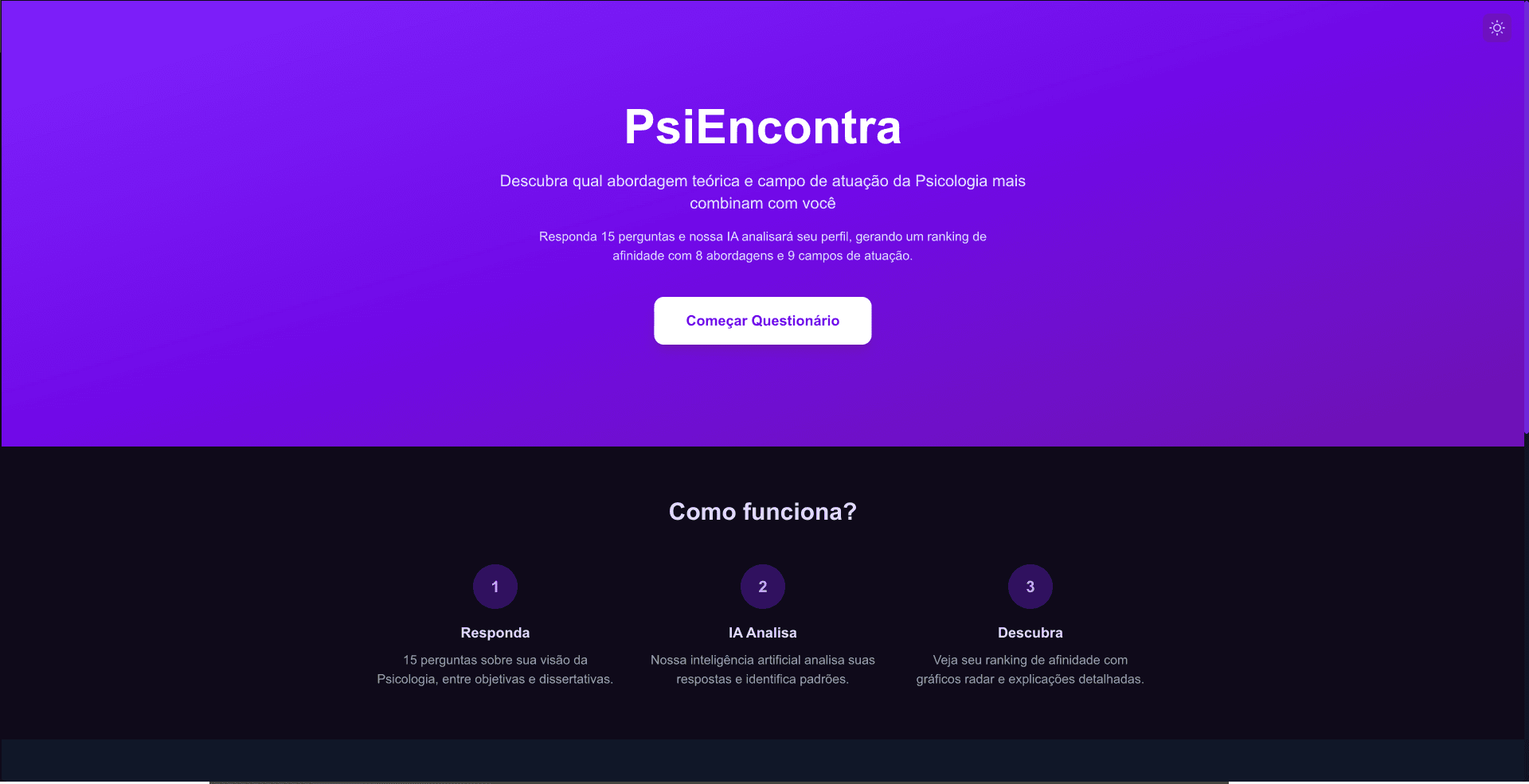
A platform that helps Psychology students find which theoretical approaches and fields of practice they relate to most. It's where my two backgrounds come together.

Problem
Early on, Psychology students run into many approaches (Psychoanalysis, CBT, Gestalt, Phenomenology…) and many fields of practice, with no practical tools to reflect on their own inclinations.
Solution
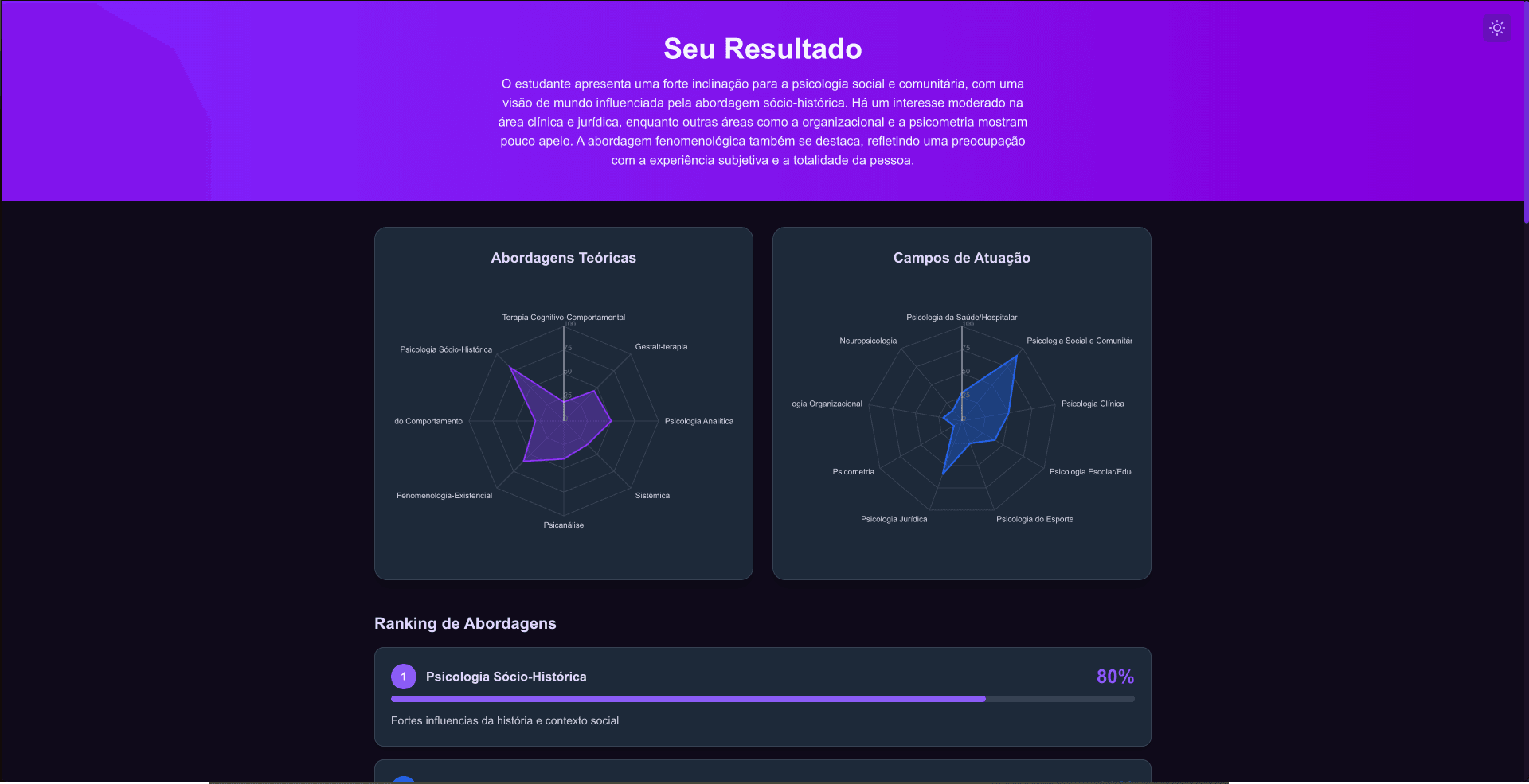
There are two questionnaire modes. In the simple one, an AI interprets open-ended answers. The detailed one has about 76 Likert items scored by a deterministic algorithm. The output is a ranking of 8 approaches and 9 fields, radar charts, personalized explanations and a PDF export.
GoGinGORMPostgreSQLNext.js 16React 19Tailwind 4RechartsGeminiGroqDockerRailwayVercel
PsiEncontra results screen with radar charts for theoretical approaches and fields of practice

Technical decisions

  • Deterministic scoring in Go

    The detailed mode uses ipsative normalization, which measures each person's deviation from their own mean. That cancels acquiescence bias and makes results reproducible. The AI only writes the text; it doesn't produce the score.

  • AI with automatic fallback

    Gemini 2.0 Flash is the primary provider. If it fails, the system switches to Groq (Llama 3.3 70B), so users still get an answer.

  • Scoped rate limiting

    Per-IP token bucket: 60 req/min overall, 10 on auth routes and 5 on answer submission, the most expensive route.

  • Anonymous flow with claim

    You can answer without an account. After signing in, you link that session to your account (JWT via cookie or Bearer, Google OAuth, bcrypt).

  • Server-generated artifacts

    The PDF is generated in Go with gofpdf, and the 1080×1920 Story image with a QR code comes from next/og, for sharing results.

Go REST API + Next.js frontend

Go Opportunities

A full platform for managing job openings, with a layered Go API and a React 19 and Next.js frontend. It runs in production with frontend, backend and database hosted separately.

Problem
I wanted a Go API base that was easy to maintain, test and extend, with a real frontend consuming it in production. A sample CRUD didn't cover that.
Solution
The API uses Gin and GORM in Handler, Service and Repository layers, is documented with Swagger and is packaged with a multi-stage Docker build. The frontend has real-time search, work-type filters, a stats dashboard, form validation, toasts and Dark Mode.
GoGinGORMPostgreSQLSwaggerDockerNext.js 16React 19Tailwind 4VercelRenderNeon
How a request flows
  1. Client
  2. Router
  3. Handler
  4. Service
  5. Repository
  6. PostgreSQL

Technical decisions

  • Layered architecture

    HTTP, business rules and data access are kept apart, so I can swap the database or test a rule without touching the rest.

  • Documented contract

    Swagger is generated from the code with swag, so the API docs don't go out of date.

  • Decoupled deploys

    Frontend on Vercel, API on Render and managed PostgreSQL on Neon. Each part scales and ships without depending on the others.

  • Lean image

    The multi-stage Dockerfile compiles the Go binary in one stage and ships a small final image.

03 / Stack

Tools I use every day

Backend

  • Go (Golang)
  • Gin
  • GORM
  • REST APIs
  • Concurrency
  • Swagger

Frontend

  • React
  • Next.js
  • React Native
  • JavaScript
  • TailwindCSS
  • Recharts

Data

  • PostgreSQL
  • Redis
  • MongoDB
  • Firestore
  • SQLite

Infra & Observability

  • Docker
  • Grafana
  • Prometheus
  • Vercel
  • Render
  • Railway
  • Neon

AI

  • LLM integration
  • Gemini
  • Groq / Llama
  • Provider fallback

04 / Education

Still learning

Finishing · 2026Geração Tech 4.0 · FullCycle · 96h

Software Engineering with AI

A software engineering program that applies AI across the whole development cycle, from environment setup to system design.

  1. 01

    Software engineering & applied AI

    Docker environments, a review of OOP, SOLID and Clean Architecture, and AI for refactoring, code review and code generation.

  2. 02

    Software quality & testing with AI

    The test pyramid, automated tests generated and analyzed with AI, and CI/CD pipelines with continuous inspection.

  3. 03

    AI workflows, APIs & LLMs

    Consuming AI APIs, building assistants, automating with n8n, and an AI-powered microservice.

  4. 04

    System design & scalable architecture

    How to design systems that grow, with AI in the architecture process.

  • Systems Analysis and Development (associate degree)

    In progress

    UNIGRANDE · 2025 to 2027

  • B.Sc. in Psychology

    Federal University of Ceará (UFC) · 2020 to 2025

  • Geração Tech 3.0: AI & Soft Skills for Developers

    Top 50 · Silver Medal

  • Introduction to Go

    Certification

  • Geração Tech 2.0

    Certification

05 / About

From Psychology to engineering

I studied Psychology at the Federal University of Ceará. I spent years learning how people think, decide and communicate, and then I moved into software development, where I've stayed.

That shows up in my work in two ways: I try to understand the problem and the people who will use the system before I open the editor, and I communicate clearly when aligning requirements, giving feedback or helping someone who's just starting out.

How I work

  • 01

    Problem before tool

    I start by understanding what needs to be solved. The technology comes after.

  • 02

    Simple and observable

    I prefer code anyone on the team can read, with metrics that show how it behaves in production.

  • 03

    End-to-end delivery

    I work from the database to the interface, including deploys.

06 / Contact

Let's talk

I enjoy talking about Go, backend and well-built products. If you'd like to swap ideas, reach out.

contact.dev.jplira@gmail.com